Every number, and what it is allowed to claim.
Umbodi measures some things and projects others, and the difference decides what it may say. This page states which is which, the threshold each number has to clear before it appears, and the ones that have not appeared yet.
Measured means read from the world. Projected means Umbodi worked it out. To know a change actually worked it uses a control group, and it will name which AI answer engine it can check for citations.
Measured, projected, and gated.
Every figure the product shows falls into one of these rows. The third column is the part most tools leave out.
| Figure | Kind | How it is obtained | What it may not claim |
|---|---|---|---|
| Search position | measured | Queried per keyword against a live search engine and stored with its date. | Never computed or interpolated. A keyword that was not checked has no number, not a stale one. |
| Traffic | measured | Read from your own Search Console once you connect it. | Your data, read on your behalf. Umbodi adds nothing to it. |
| Answer citations | measured | Your question is put to every answer engine we hold a key for, and each one’s cited sources are checked for your domain. | Scoped to the engines that return their sources — five today. Every verdict says how many were asked; engines whose sources cannot be queried are not claimed. |
| Change went live | measured | The page is re-fetched after publishing and the change is looked for in the response. | If it is not in the response, the proposal is not closed. |
| Expected lift | projected | Scored from the finding type, the page and the project's own history. | A projection, shown in the projection colour, never mixed into a measured figure. |
| Answer-readiness | projected | A score for how quotable a page is: direct answer, heading structure, FAQ markup. | A projection about a model's behaviour, which nobody can measure directly. |
| Attributed gain | measured, gated | The change arm compared against the deliberately-withheld control arm. | Emitted only above twenty observations per arm. Below that it returns nothing at all. |
Four rules that decide when a number may appear.
These are constants in the code, not editorial policy. They are the reason some screens show a dash where a competitor would show a figure.
A tenth of eligible fixes are withheld
So movement can be compared against comparable pages that were left alone. Without a control arm, “our fix earned you three positions” is a story with a number attached.
Twenty observations per arm, or no estimate
Below the threshold the estimator returns nothing rather than a small number, because a small number reads as a weak effect when it actually means a thin sample.
Three contributing projects before anything is pooled
Cross-site learning is readable by anyone holding the public key, and an aggregate over one project is that project's decision profile. The floor makes the privacy promise true by construction rather than by the table happening to be empty.
Not measured renders as a dash
A zero that means “we did not look” is treated here as a defect. Every count that can be absent has a state for absent.
It reads your site before it writes anything
A paid research pass builds a brand profile from your own pages — what you sell, to whom, in what words — and every later decision reasons from it. That is why the copy it proposes is yours rather than generic, and why a project with no knowledge base is asked to build one first.
What has produced a result, and what has not.
A capability that is built and running is not the same as a capability that has produced a number. Stating the difference costs us a claim and buys the rest of the page its credibility.
Running, with results
The audit, the pull request, the live check that a change reached your page, closing what is fixed, and per-project learning from your own approvals. These have all produced real output on real sites.
Running, no result yet
Attributed gain. The control arm is being withheld on every eligible fix, and the estimator has never emitted a figure because no arm has reached twenty observations. It will stay silent until it does.
Waiting on scale, not on code
Pooled cross-site learning. The aggregate runs weekly and correctly writes nothing, because fewer than three projects have opted in. That is a customer count, and no change to the product will move it.
Where every number comes from.
Each source answers one question, and none of them stands in for another. A figure from one source is never mixed into a figure from another.
| Source | What it provides | How it is obtained | What it is not |
|---|---|---|---|
| Google search results | Search positions | Queried per keyword against Google through a search-results provider, and stored with the date of the check. | Measured, never computed. Positions are Google’s only; no other search engine’s ranking is reported. |
| Google Search Console | Clicks and impressions | Read through Google’s API for each property you connect, after you authorise it. | Only for properties you connect. Without a connection there is no traffic figure, and it shows as a dash. |
| Sitemap and IndexNow | Announcing new and changed pages | Your sitemap is submitted through Search Console, and changed URLs are sent to IndexNow, which shares them with Bing, Yandex and the other engines that take part. | A submission, not proof of indexing. Whether and when a page is indexed is the search engine’s decision. |
| Bing Webmaster Tools | Bing clicks, queries, inbound links and crawl issues | Read through Bing’s API, labelled “measured by Bing” and stored apart from Google’s figures. | For the sites verified in the Bing account whose API key you add in your account. Without a key, only Umbodi’s own site. |
| AI answer engines | Whether an answer cites your site | Five engines are asked: Perplexity, Anthropic web search, OpenAI web search, Gemini and Google’s AI Overview. Questions are reported in three sets — your brand, narrow questions drawn from your own pages, and generic questions — and the sets are never added together. Where a project has a market, the engines are asked from it; Gemini cannot be asked from a market. | Microsoft Copilot is not measured: Bing’s AI Performance report has no API. |
One real run, on one of our own sites.
Three frames from a real audit of beastories.mu, a site we own. Nothing is staged: this is the engine, the findings it returned, and the fix it wrote.

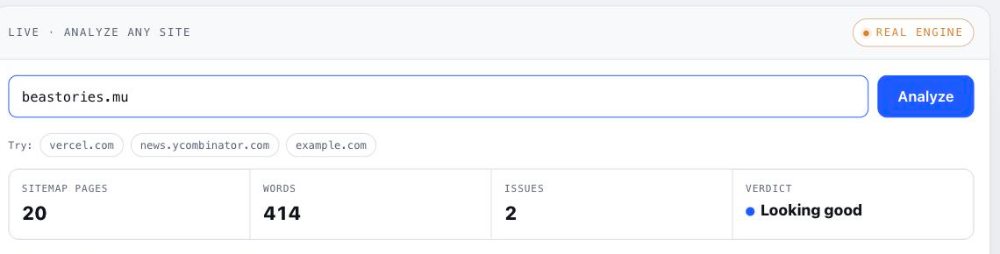
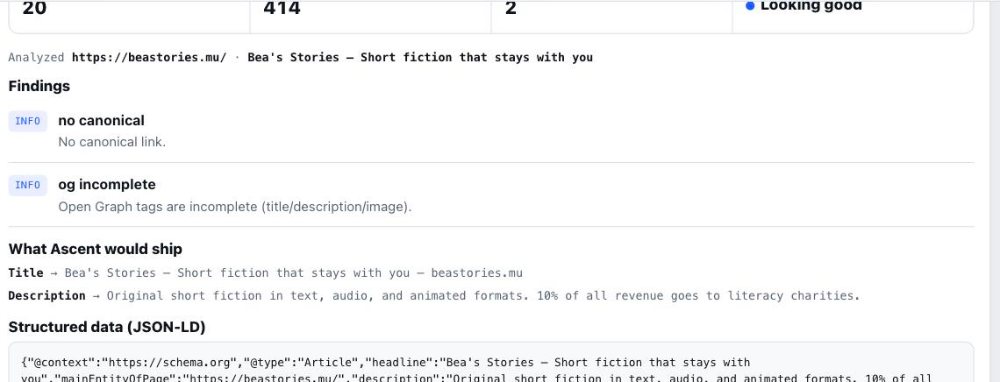
This is the free half. What it cannot show you is a live ranking, a competitor or an AI citation, because each of those calls a paid service.
Questions about the method.
How does Umbodi know a change actually worked?
Umbodi withholds a tenth of eligible fixes as a control group and compares the two arms, so a reported gain is attributed rather than assumed. The estimator refuses to emit a figure below twenty observations per arm and returns nothing rather than a zero, because not measured and no effect are different answers.
What is measured and what is estimated?
A rank read from a search engine, traffic from your own Search Console and a citation checked against an answer engine are measured. An expected lift, an answer-readiness score and a priority score are projections. The two never share a number, a colour or a sentence, and the rule is enforced in the test suite.
Which AI answer engines does Umbodi check?
Five: Perplexity, Anthropic web search, OpenAI web search, Gemini and Google’s AI Overview, because each returns the sources it used and can therefore be checked. Umbodi asks your question and looks for your domain among those sources. Every answer carries how many engines were asked, because “not cited” by one engine and by five are different findings. It does not claim to measure citations in engines whose sources cannot be queried, and it labels the scope rather than implying coverage it does not have.
Does Umbodi learn from my decisions?
Yes, per project, from your own approvals and rejections. That runs on your tenant's own data and needs no other customer. A second, pooled prior across sites exists but stays silent until three distinct projects have opted in and contributed, because an aggregate built from fewer would publish one customer's decision profile.
Run it on something you own.
Create an account and audit your own site. It costs nothing and calls no paid service.